

Level 1/2/3/4/5 schedules
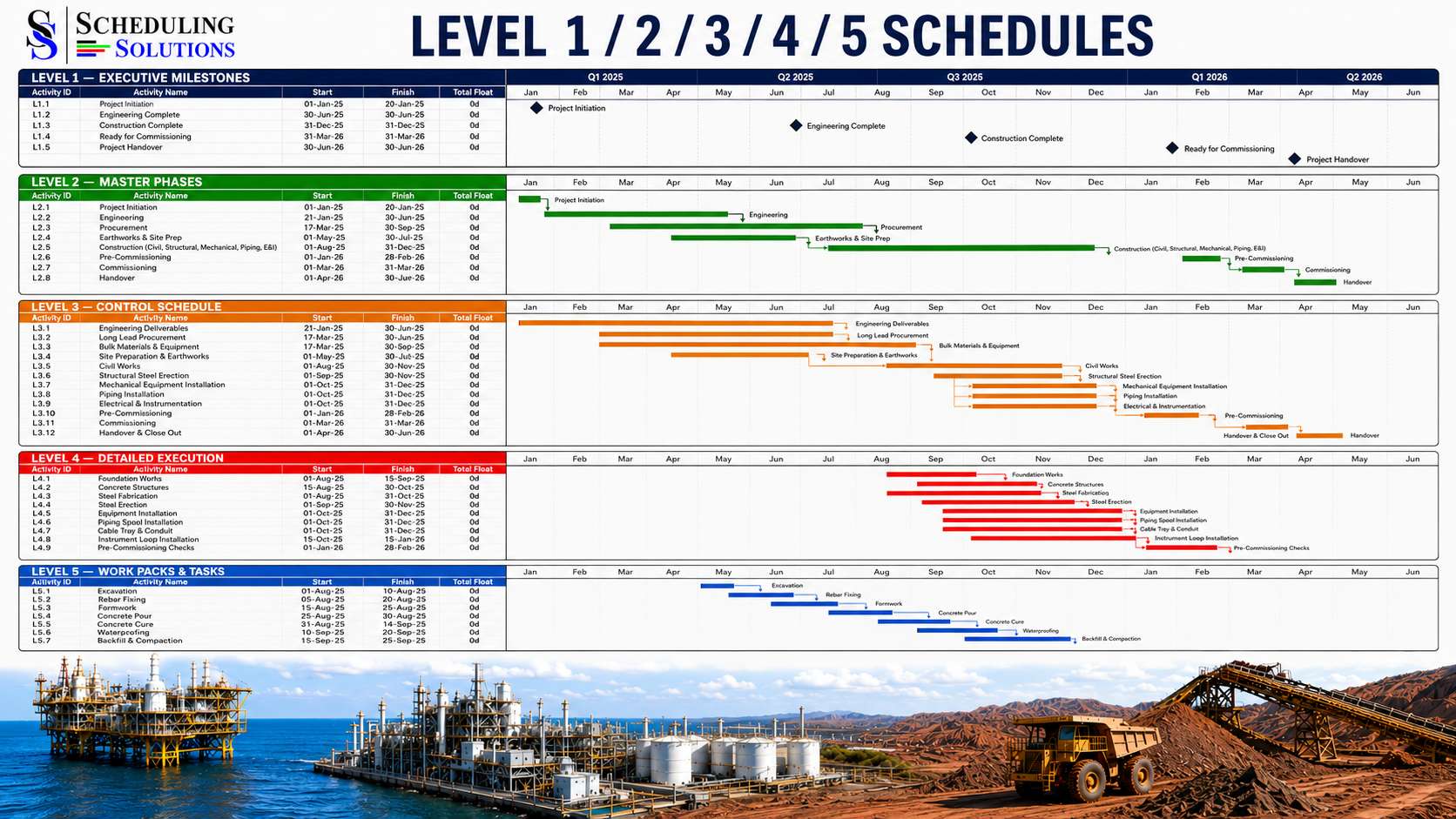
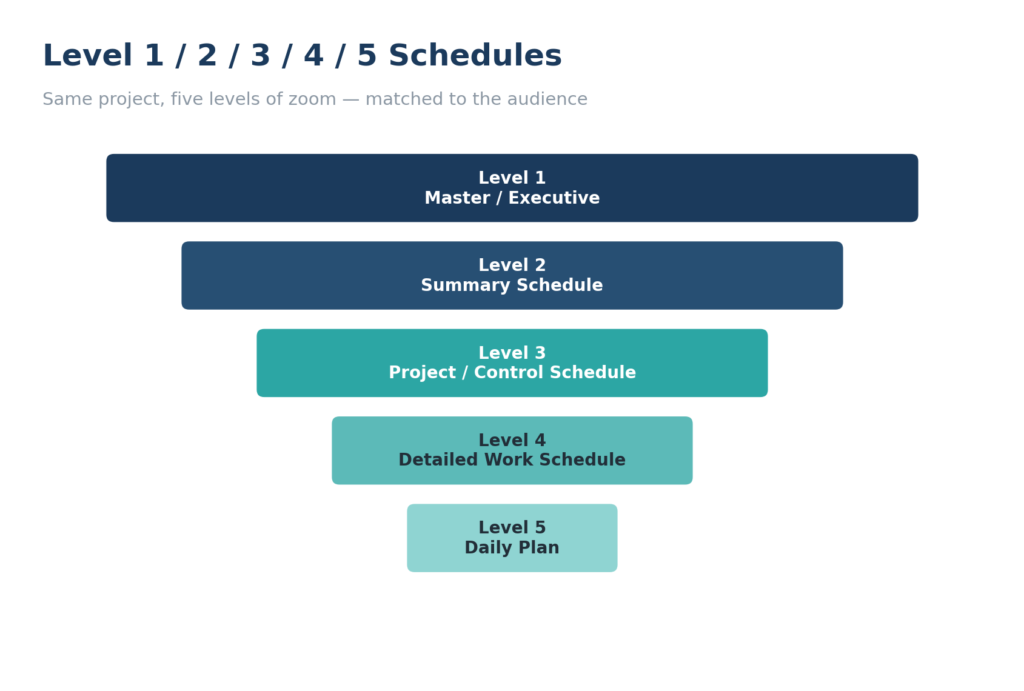
Schedule “levels” describe the amount of detail in a programme, similar to zoom levels on a map.
• Level 1 (Master/Executive Summary):
A handful of key phases and milestones — suited to board packs and executive reporting.
A handful of key phases and milestones — suited to board packs and executive reporting.
• Level 2 (Summary Schedule):
Major work areas, disciplines, or facilities rolled up — used for client monthly reporting.
Major work areas, disciplines, or facilities rolled up — used for client monthly reporting.
• Level 3 (Project/Control Schedule):
The most commonly used level — a fully logic-linked programme broken down by area, discipline, or WBS, used to actually run the job on a weekly/monthly cycle. This is the schedule most contracts across mining, oil & gas, utilities, and commercial construction require as the contractual baseline.
The most commonly used level — a fully logic-linked programme broken down by area, discipline, or WBS, used to actually run the job on a weekly/monthly cycle. This is the schedule most contracts across mining, oil & gas, utilities, and commercial construction require as the contractual baseline.
• Level 4 (Detailed Work Schedule):
A weekly cut for supervisors and leading hands, resource-loaded to control day-to-day productivity.
A weekly cut for supervisors and leading hands, resource-loaded to control day-to-day productivity.
•Level 5 (Daily Plan)
The most granular level — daily task lists for crews, or hour-by-hour for high-intensity work like a shutdown or turnaround.
The most granular level — daily task lists for crews, or hour-by-hour for high-intensity work like a shutdown or turnaround.
Why it matters
Using the wrong level for the wrong audience causes real problems: a Level 5 daily task list is unusable in a board report, and a Level 1 milestone chart is useless for actually running a crew day to day. Most contractors need a solid Level 3 to satisfy contractual requirements and a Level 4 to run the job on-site — everything else can usually be generated from that same underlying schedule rather than maintained separately.
What's included in our deliverable
- We build your schedule once, at the appropriate base level of detail, then derive the summary and detailed views you need from it — so every level stays consistent with the others.
When to order one
Level 1-2 for executive and client reporting; Level 3 as your contractual baseline; Level 4 for site supervision; Level 5 only where daily or hourly-level control is genuinely required (common on shutdowns, turnarounds, and highly constrained work fronts).